English
 Deutsch
Didn't find a product that suits you?
Contact us for the latest news.

A shock absorber working on a 40-tonne loaded semi-trailer faces a fundamentally different set of demands than one on a passenger car. The loads are heavier, the distances are longer, the maintenance windows are fewer, and the consequences of failure — sway, instability, cargo damage, driver fatigue — are more serious. Choosing between hydraulic and gas shocks in this context is not a comfort preference. It is an operational decision with safety and cost implications that compound over hundreds of thousands of kilometres.
Content
Every shock absorber converts kinetic energy into heat through fluid resistance. In a passenger car, that heat load is intermittent — a pothole here, a corner there. In a heavy truck or trailer traveling a long-haul route, the shock is working almost continuously, compressing and rebounding with every road irregularity across hours of uninterrupted operation.
Hydraulic shocks depend on consistent oil viscosity to deliver consistent damping. As heat builds in the oil during sustained operation, viscosity drops — the oil flows more easily through the piston valves, offering less resistance, less control. Dissolved air simultaneously forms micro-bubbles in the fluid, a process called aeration, which introduces compressible material into what should be an incompressible damping medium. The combined effect is shock fade: a gradual and sometimes rapid loss of damping performance while the vehicle is still in motion.
For a passenger car completing a short commute, mild fade at the end of the journey is barely perceptible. For a heavy truck at highway speed with a trailer, fade that affects damping by 20–30% is enough to alter body roll behavior, increase the risk of trailer sway in crosswinds, and reduce driver confidence and control. Gas-charged shocks address this problem directly, not by eliminating heat generation but by maintaining oil integrity under heat through pressurized nitrogen that prevents both aeration and viscosity-driven performance loss.
Heavy truck chassis carry axle loads that passenger-car shock engineers never design for. A single drive axle on a loaded Class 8 truck may carry 9 tonnes or more. The shock absorbers on that axle are not just controlling ride quality — they are managing dynamic load transfer during braking, acceleration, and cornering, all of which affect both driver safety and cargo integrity.
Hydraulic shocks on heavy truck chassis perform adequately in lightly loaded or slow-speed applications. On agricultural equipment, municipal trucks operating at low speed, or vehicles with infrequent high-load cycles, the fade limitation rarely becomes the dominant factor.
For long-haul, high-speed, or consistently loaded operations, gas-charged shocks are the appropriate specification. The nitrogen pre-charge maintains consistent damping force across the full operating temperature range, ensuring the shock's contribution to axle stability remains predictable whether it is the first hour of a route or the twelfth. The heavy truck chassis shock absorbers for Class 6–8 and commercial vehicle platforms are designed with exactly this sustained-load performance requirement as the primary engineering constraint.
The cab isolation system on a heavy truck works differently from the chassis suspension but faces the same hydraulic vs gas trade-off. Cabin shocks — or drive-down cabin dampers — control the movement of the cab relative to the chassis, filtering out the vibrations and jolts that would otherwise reach the driver directly.
Driver fatigue is a documented occupational hazard in long-haul trucking, and whole-body vibration transmitted through the seat and cabin is a contributing factor. Research on occupational vibration in commercial vehicle operators consistently links sustained exposure to low-frequency vertical vibration (typically 1–20 Hz) with increased fatigue and musculoskeletal stress. A cabin shock that fades after two hours of highway driving stops providing meaningful vibration attenuation precisely when the driver has already accumulated hours of cumulative exposure.
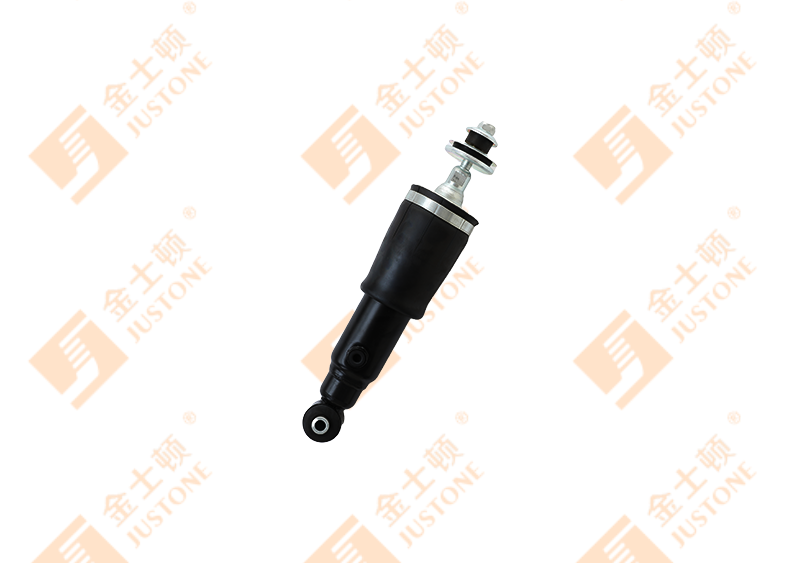
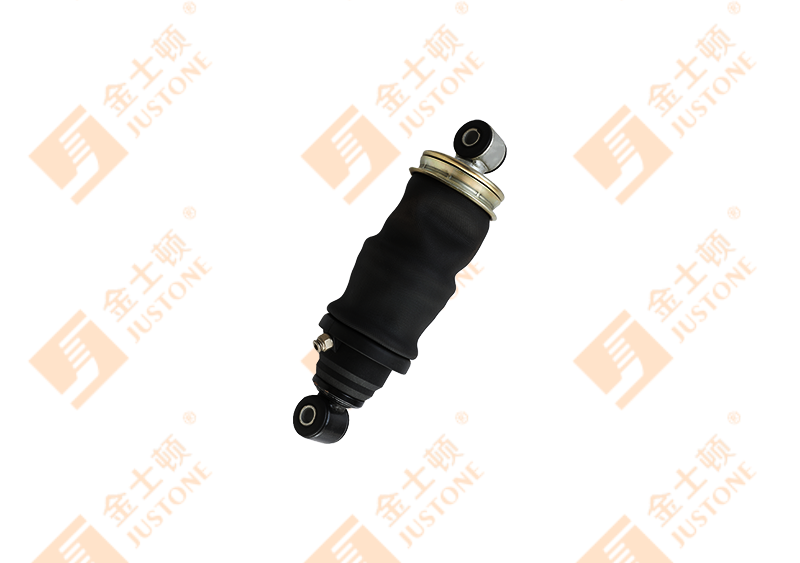
Gas-charged cabin shocks maintain their damping characteristics through the full shift. The response is not just firmer — it is more consistent, which means the cabin's resonant behavior stays predictable and the driver's exposure to peak vibration events is better controlled. The cabin shock absorbers for heavy truck and commercial vehicle cabins and the drive-down cabin shock systems for integrated cab suspension platforms are both available in gas-charged configurations that sustain performance across the full duty cycle.
Trailers are often the afterthought in suspension discussions, but the dynamics of a trailer with degraded shock absorption affect the entire vehicle combination. Trailer sway — the oscillating side-to-side movement of a trailer that, in severe cases, causes loss of control — is exacerbated by inadequate damping at the trailer axles. When shocks fail to control axle movement, tire contact with the road becomes inconsistent, and the lateral forces that initiate sway are not countered effectively.
Hydraulic trailer shocks deliver acceptable performance under moderate conditions and represent a cost-effective solution for light-duty trailers or those operating on smooth, well-maintained roads. The economics of the trailer market — high unit volumes, competitive pricing pressure, frequent replacement cycles — mean hydraulic units often remain the standard specification for commercial trailers.
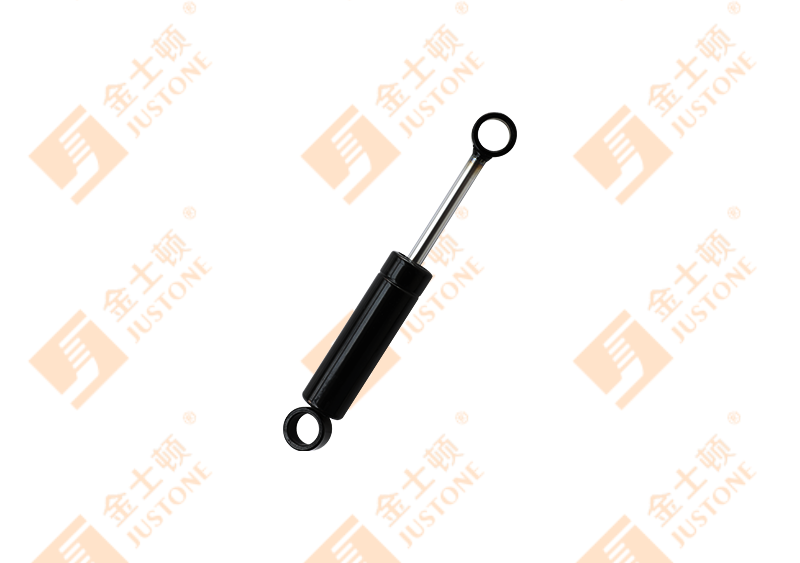
For trailers regularly operating at or near capacity, on road surfaces with significant irregularities, or in markets where shock replacement intervals are long, gas-charged units provide meaningful advantages in fade resistance and stability preservation. The trailer shock absorbers for single-axle and tandem-axle commercial trailer configurations and trailer damper systems for specialized trailer suspension requirements address both ends of this spectrum.
Even the best-specified chassis and cabin shocks do not eliminate all vibration reaching the driver. The seat suspension — incorporating a seat damper — acts as the final isolation stage between the vehicle structure and the occupant. In heavy truck applications, seat dampers work hardest during low-speed operations on rough surfaces: construction sites, quarries, agricultural fields, and port roads where the chassis suspension is not optimized for that terrain.
The same hydraulic vs gas comparison applies here. A hydraulic seat damper provides smooth isolation under light, intermittent inputs but can fade during sustained rough-terrain operation. Gas-charged seat dampers maintain consistent attenuation through the working day, which directly affects driver comfort and, over the long term, health outcomes related to occupational vibration exposure. The seat damper solutions for heavy truck and commercial vehicle operator seating are designed to bridge this gap between chassis-level isolation and operator-level protection.
Fleet operators evaluating hydraulic vs gas shocks must look beyond the unit price. The relevant economic comparison is total cost of ownership across the vehicle's service life, accounting for replacement frequency, labor costs, and the downstream effects of inadequate shock performance.
| Factor | Hydraulic Shocks | Gas-Charged Shocks |
|---|---|---|
| Unit cost | Lower | Higher (typically 20–60% premium) |
| Service life under heavy use | Shorter — oil degradation accelerates under load | Longer — nitrogen charge slows oil breakdown |
| Performance over service life | Gradual fade begins well before failure | More consistent until near end of service life |
| Failure mode | Oil leaks — visible, easier to catch | Nitrogen loss — less visible, needs pressure testing |
| Driver fatigue contribution | Higher as shocks age and fade | Lower — more sustained vibration attenuation |
| Cargo protection | Moderate — diminishes with shock fade | Better — consistent damping protects cargo |
For high-utilization fleets — those covering over 150,000 km annually, consistently loaded, or operating on roads with significant pavement deterioration — the total cost calculation typically favors gas-charged shocks despite the higher unit price. Fewer replacements over the vehicle's life, reduced driver fatigue-related incidents, and better cargo protection are all cost items that compound positively over time.
No single shock specification fits every commercial vehicle application. The decision framework for fleet buyers and truck operators should account for the following:
The full range of shock absorber products for heavy trucks, trailers, and commercial vehicle platforms covers every position in the vehicle — from chassis axles to cabin mounts to operator seating — with both hydraulic and gas-charged options for each application, allowing specification decisions to be made at the component level rather than the fleet level.
Contact us for the latest news.
Copyright @ Hangzhou Justone Industry Co., Ltd.
 OEM Commercial Vehicle Shock Absorbers Manufacturers
Wholesale Car Shock Absorbers Factory
OEM Commercial Vehicle Shock Absorbers Manufacturers
Wholesale Car Shock Absorbers Factory