English
 Deutsch
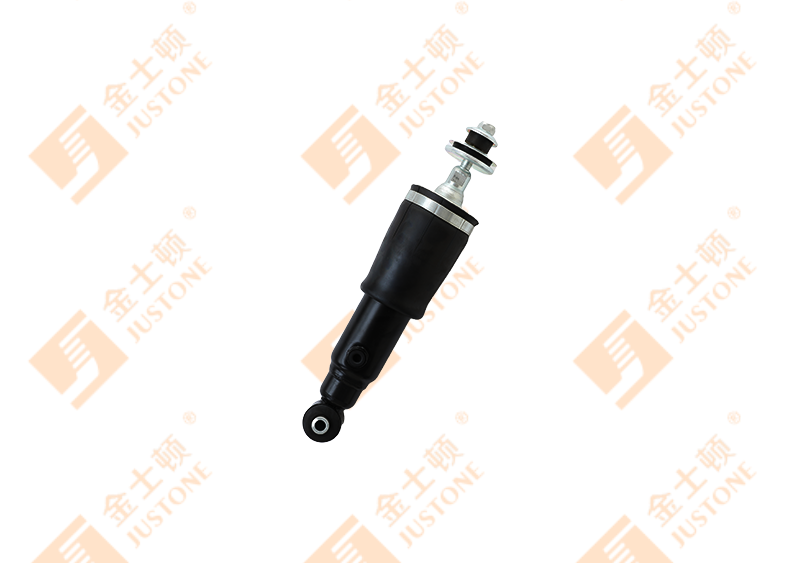
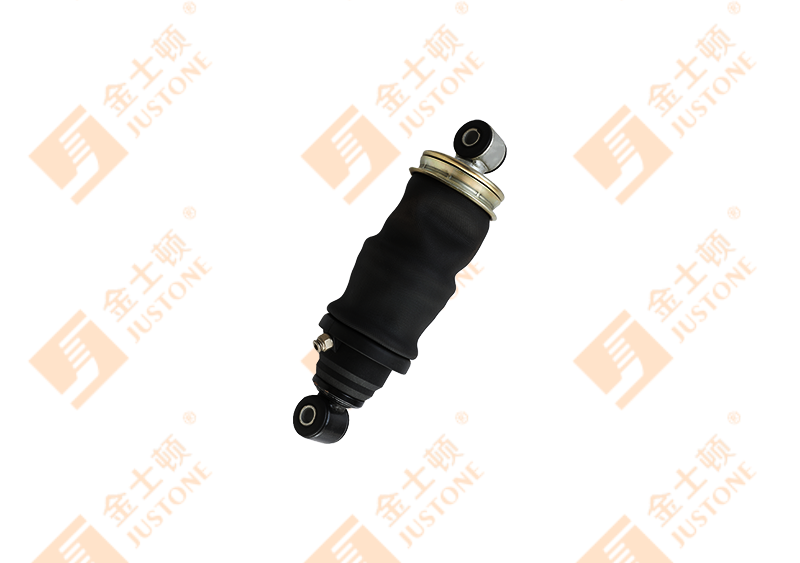
Didn't find a product that suits you?
Contact us for the latest news.

What Shock Absorbers Actually Do — and Why the Fluid Matters
Every time a wheel hits a bump, a pothole, or an uneven surface, the suspension spring compresses to absorb the impact energy. Left unchecked, that spring would continue bouncing — releasing and re-compressing — for several cycles before returning to its rest position. The shock absorber's job is to stop that bouncing. It does this by converting the kinetic energy of the spring's movement into heat, using the resistance of fluid being forced through a precisely calibrated valve inside a sealed cylinder.
The fluid is not incidental to this process — it is the process. The rate at which fluid moves through the valve determines the damping force. The viscosity of that fluid under changing temperature conditions determines how consistently that force is delivered over time. And the presence or absence of pressurised gas inside the shock determines how well the fluid maintains its properties when the system is working hardest.
Both hydraulic and gas shock absorbers use fluid as the damping medium. What separates them is what else is inside — and how that difference plays out under load, heat, and high-frequency vibration.
Content
A hydraulic shock absorber is built around a straightforward principle: a piston attached to the suspension moves up and down inside a cylinder filled with hydraulic oil. As the piston moves, it forces oil through small orifices or valve passages in the piston head. The resistance generated by that restricted flow is the damping force — the force that slows the spring and prevents uncontrolled bouncing.
The design is mechanically simple, which gives hydraulic shocks several practical advantages. They are relatively inexpensive to manufacture, straightforward to maintain, and well-proven across decades of application in passenger vehicles, light commercial transport, and standard industrial equipment. For vehicles operating at moderate speeds on reasonably consistent road surfaces, hydraulic damping is entirely adequate.
The limitation of purely hydraulic shocks emerges under conditions of sustained or high-frequency load. As the piston cycles repeatedly at speed, it generates heat — and that heat transfers into the oil. Warmer oil has lower viscosity than cool oil, which means it flows through the valve passages more easily. As viscosity drops, damping force drops with it. The shock progressively loses its ability to control the spring, a condition known as shock fade. A secondary problem compounds this: under aggressive cycling, air that exists in the oil can become entrained as bubbles, creating a compressible foam layer that further degrades damping consistency. These are the conditions under which hydraulic shocks show their structural weakness.

A gas shock absorber uses the same hydraulic damping principle as its hydraulic counterpart — oil forced through valve passages to create resistance — but adds pressurised nitrogen gas to the system. The gas is sealed in its own chamber, separated from the oil by a floating piston or a flexible membrane, and maintained at pressures typically ranging from 100 to 360 psi depending on the application and manufacturer specification.
Nitrogen is chosen specifically because it is chemically inert and dry. Unlike atmospheric air, which contains moisture and oxygen that can interact with the oil and internal components over time, nitrogen remains stable across the operating temperature range of a shock absorber. It does not react with the hydraulic fluid, does not introduce moisture, and does not support oxidation of internal surfaces.
The pressurised gas performs two critical functions. First, it applies constant positive pressure to the oil, which prevents air from coming out of solution and forming bubbles under rapid cycling. Foam cannot develop in oil that is held under pressure, because any dissolved gas remains dissolved rather than nucleating into bubbles. Second, the gas pressure assists the piston's extension stroke — the return movement after compression — making the shock respond faster to road surface changes and keeping the wheel in more consistent contact with the ground. The result is quicker response, more consistent damping force delivery, and significantly better resistance to fade under sustained load.
Shock fade is not a minor inconvenience — in commercial vehicle and industrial equipment contexts, it is a safety and productivity issue. Understanding the mechanism makes the consequences concrete.
As a shock cycles under load, each compression and extension stroke generates heat through the friction of oil passing through the valve passages. In normal operating conditions, that heat dissipates through the shock body into the surrounding air quickly enough to maintain stable oil temperature. Under sustained high-frequency loading — a heavy truck on a rough road, a trailer bouncing over uneven ground, an ATV navigating broken terrain at speed — heat is generated faster than it can be dissipated. Oil temperature rises, viscosity falls, and the damping force the shock can deliver decreases. The driver or operator experiences this as a progressive loss of suspension control: increased body roll, reduced stability under braking, and a bouncier, less predictable ride that worsens the longer the conditions persist.
In a twin-tube hydraulic shock, this process is accelerated by the limited oil volume and the constricted path available for heat to escape through the outer tube. In a mono-tube gas shock, the larger oil volume, direct contact between the oil chamber and the outer tube wall, and the gas pressure's suppression of foaming all work together to delay the onset of fade substantially. For applications where a shock is expected to work hard for extended periods without recovery time, the difference between the two is not marginal — it is the difference between a shock that maintains control and one that progressively abandons it.
Understanding how drive-down cabin shock absorbers minimise vibrations in the vehicle cab is inseparable from understanding fade — a cabin shock that fades under load stops absorbing the frequencies that cause driver fatigue and long-term musculoskeletal stress.
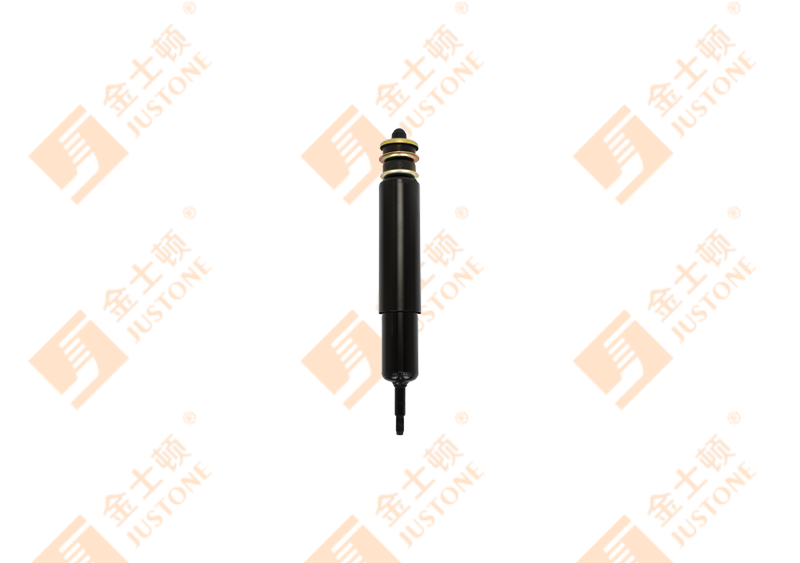
The gas vs hydraulic distinction is closely related to — but not identical with — the mono-tube vs twin-tube structural distinction. Understanding both helps buyers specify precisely what they need.
| Feature | Twin-Tube (Hydraulic) | Mono-Tube (Gas) |
|---|---|---|
| Structure | Inner working cylinder inside outer reservoir tube | Single pressure tube containing oil and gas chambers |
| Gas charge | Low-pressure or none | High-pressure nitrogen (100–360 psi) |
| Heat dissipation | Limited — oil contacts outer tube indirectly | Superior — oil contacts outer tube directly |
| Oil volume | Smaller per unit size | Larger — better thermal capacity |
| Installation flexibility | Can be mounted at any angle | Typically requires near-vertical orientation |
| Cost | Lower | Higher — tighter manufacturing tolerances |
| Fade resistance | Moderate | High |
| Best for | Standard loads, moderate conditions | Heavy loads, high-frequency, performance |
Twin-tube designs dominate the hydraulic shock category, and their ability to be mounted at any angle makes them well-suited to constrained installation geometries in passenger vehicles and lighter equipment. Mono-tube gas shocks require more precise installation orientation — the floating piston that separates the gas and oil chambers relies on gravity and gas pressure to remain correctly positioned — but deliver superior thermal performance and damping consistency as a result of their larger oil volume and direct-wall heat transfer.
For commercial and industrial applications where the shock is expected to operate continuously under significant load, mono-tube gas construction is the professional specification. The higher initial cost is routinely justified by extended service intervals, more consistent in-service performance, and reduced maintenance requirements over the equipment's operational life.
The gas vs hydraulic decision becomes straightforward when it is grounded in the actual operating conditions of each application. Below is a practical mapping of shock type to end use across the key commercial and industrial categories.
Heavy trucks operate under conditions that expose shock absorbers to sustained high-frequency vibration, significant static load, and extended duty cycles without recovery time. A fully laden goods vehicle on a motorway generates continuous damping demand that pushes hydraulic shocks toward their thermal limits within hours. Gas-charged shocks are the correct specification for heavy truck chassis applications — their fade resistance, superior heat dissipation, and consistent damping force under load directly translate into better vehicle stability, reduced braking distances, and lower driver fatigue over long hauls. Heavy truck chassis shock absorbers for demanding road conditions are engineered to the load ratings and stroke specifications that commercial vehicle suspension geometry requires.
For a detailed analysis of the broader factors that determine heavy truck chassis stability — including suspension geometry, load distribution, and damping selection — the article on key factors affecting the stability of heavy truck chassis provides the full engineering context.
Trailer shock specification depends heavily on the load profile. Lightly loaded trailers running on good roads can be adequately served by hydraulic shocks — the damping demands are moderate and heat generation is controlled. Trailers carrying variable or heavy loads, operating over rough terrain, or subject to aggressive braking loads from the towing vehicle should be specified with gas shocks. The dynamic load transfer during braking generates sharp, high-amplitude shock inputs that hydraulic dampers handle less consistently. Trailer shocks engineered for load stability and control cover the full specification range from standard to heavy-duty gas-charged construction.
Off-road applications are among the most demanding environments for shock absorbers. Rough terrain generates high-amplitude, unpredictable inputs at variable frequencies; the shock has no opportunity to dissipate heat between impacts; and wheel control is critical for both performance and safety. Gas shocks are the unambiguous specification for ATV and off-road equipment — hydraulic shocks fade rapidly under these conditions, producing a progressive loss of wheel control that is both uncomfortable and dangerous at speed. ATV shock absorbers for off-road performance are designed to withstand the combined stresses of high amplitude, high frequency, and sustained duty that off-road operation imposes.
Cabin and seat shock absorbers operate in a different frequency domain from chassis shocks — they are designed to filter the high-frequency vibration that passes through the chassis into the operator environment, rather than to control large suspension movements. The specification logic still applies: for vehicles operating over rough ground or long distances, gas-charged cabin and seat dampers maintain more consistent isolation performance over extended periods than hydraulic alternatives. Cabin shocks designed to reduce driver fatigue on long hauls and seat dampers for operator comfort in heavy equipment address the two principal vibration transmission paths into the operator — the cab structure and the seat itself — and specifying both correctly delivers compounding benefit to driver health and concentration over a working shift.
As a practical decision framework: if the application involves sustained load, high-frequency inputs, extended duty cycles, rough terrain, or any combination of the above, gas shocks are the correct specification. If the application involves standard loads, moderate road conditions, and budget is the primary constraint, hydraulic shocks deliver reliable service. The cost difference between the two diminishes significantly when the full lifecycle is considered — longer service intervals, more consistent performance, and reduced maintenance frequency from gas-charged systems regularly offset the higher initial unit cost within the first service cycle of a commercial vehicle or piece of industrial equipment.
Specifying correctly at the procurement stage is always less expensive than correcting an underspecified shock absorber after the equipment is in service.
Contact us for the latest news.
Copyright @ Hangzhou Justone Industry Co., Ltd.
 OEM Commercial Vehicle Shock Absorbers Manufacturers
Wholesale Car Shock Absorbers Factory
OEM Commercial Vehicle Shock Absorbers Manufacturers
Wholesale Car Shock Absorbers Factory