English
 Deutsch
Didn't find a product that suits you?
Contact us for the latest news.

Content
Every time your vehicle hits a pothole, crosses a speed bump, or navigates a gravel road, your shock absorbers are doing the invisible work of keeping your tires planted and your cabin comfortable. Shock absorbers — also called dampers — do not support the weight of the vehicle; that job belongs to the springs. What shocks do is control how quickly and smoothly those springs move. Without them, your car would bounce repeatedly after every bump, making the ride dangerous as well as uncomfortable.
At their core, all shock absorbers convert the kinetic energy of suspension movement into heat through hydraulic resistance. A piston moves through a chamber filled with fluid, forcing that fluid through small valves. The resistance created by this process slows the movement of the suspension. The key difference between shock types comes down to what is inside that chamber — and how well the design holds up under heat and repeated stress.
Hydraulic shock absorbers use oil as the sole medium for damping. As the piston moves through the oil-filled chamber, the fluid is pushed through calibrated valves, generating resistance that slows suspension travel. The design is mechanically simple, well-understood, and has been the standard fitment on passenger vehicles for decades.
The main advantages of hydraulic shocks are their cost and ride comfort. Because the design involves fewer components and lower manufacturing tolerances, hydraulic shocks are generally less expensive to produce and purchase. On smooth pavement, the slightly slower damping response of oil-only shocks translates into a softer, more compliant feel — which is exactly why classic and vintage cars were engineered with hydraulic dampers from the factory.
The drawback emerges under stress. When hydraulic shocks are pushed hard — through repeated bumps at speed, heavy towing, or spirited cornering — the oil heats up and air can mix with the fluid, causing it to foam. This foaming dramatically reduces the shock's ability to damp effectively, a condition known as shock fade. Once fade sets in, the suspension bounces more freely, handling becomes vague, and braking distances can increase. For vehicles used primarily in mild, everyday conditions, shock fade is rarely a concern. For anything more demanding, it becomes a meaningful limitation.
Gas shock absorbers share the same fundamental oil-and-piston design as hydraulic units, but with one critical addition: pressurized nitrogen gas is injected into the chamber alongside the hydraulic fluid. This gas — typically charged at 100 to 360 PSI depending on the design — separates from the oil using either a floating piston (monotube design) or a secondary chamber (twin-tube design).
The nitrogen serves a precise purpose: it prevents the oil from foaming under duress. Because air compresses and oil does not, a hydraulic shock must first compress any trapped air before the piston can force oil through the valve — creating a brief lag in response. In a gas-charged shock, the pressurized nitrogen eliminates air pockets entirely, allowing the piston to act immediately on the oil without delay. The result is faster, more consistent damping.
This translates into real-world benefits: better body control, reduced brake dive and acceleration squat, improved tire contact with the road surface, and superior resistance to fade during extended hard use. Gas shocks are the standard choice for performance vehicles, off-road trucks, towing applications, and any situation where the suspension is repeatedly pushed to its limits.
The trade-offs are modest but real. Gas shocks cost more than equivalent hydraulic units, and the internal pressure means they extend themselves when unloaded — which can make installation slightly more involved. The firmer response also means that sharp, small bumps are transmitted to the cabin more readily, which some drivers find less comfortable on glass-smooth highways.

| Factor | Hydraulic Shocks | Gas Shocks |
|---|---|---|
| Damping medium | Oil only | Oil + pressurized nitrogen |
| Response speed | Slightly slower (air lag) | Faster, more immediate |
| Ride feel | Softer, more compliant | Firmer, more controlled |
| Fade resistance | Lower — degrades under heat | High — maintains performance under stress |
| Cost | Lower upfront cost | Higher upfront cost |
| Best for | Daily driving, classic cars, smooth roads | Off-road, towing, performance, heavy use |
| Typical service life | 40,000–60,000 miles (standard use) | 50,000–80,000 miles (varies by application) |
The right shock absorber depends almost entirely on how and where you drive. There is no universally superior option — only the right fit for your specific application.
For daily commuting and standard passenger vehicles, hydraulic shocks remain a perfectly valid and cost-effective choice. If your driving is predominantly highway and city roads, the softer ride character of a hydraulic unit can actually be preferable. The conditions that trigger shock fade — sustained high-speed bumps, heavy towing, repeated hard cornering — simply do not arise in typical daily use.
For off-road driving, towing, and hauling, gas shocks are the clear choice. The resistance to fade is not a marketing claim in these contexts — it is a functional requirement. A hydraulic shock working hard on a washboard dirt road or managing the weight of a loaded trailer will begin to fade, with measurable consequences for stability and control. If you are also considering a suspension lift, pairing gas shocks with an appropriate lift kit is strongly recommended; see our truck lift and shock guide for detailed guidance on matching shocks to lift height.
For classic and vintage vehicles, hydraulic shocks are often the more historically appropriate choice. These vehicles were engineered around the damping characteristics of oil-only units. Fitting gas shocks to a classic car can produce a ride that feels noticeably stiffer than intended, and some restorers specifically seek hydraulic replacements to preserve the original driving character.
For performance and sport applications, gas shocks — particularly monotube designs — deliver the consistent, fade-resistant damping that spirited driving demands. Drivers seeking even greater control over their suspension tune may want to explore adjustable shock absorbers, which allow compression and rebound damping to be dialed in for specific conditions. For heavy-duty vehicles like Class A and Class C motorhomes, refer to our guide on motorhome shock absorbers for weight-rated replacement options.
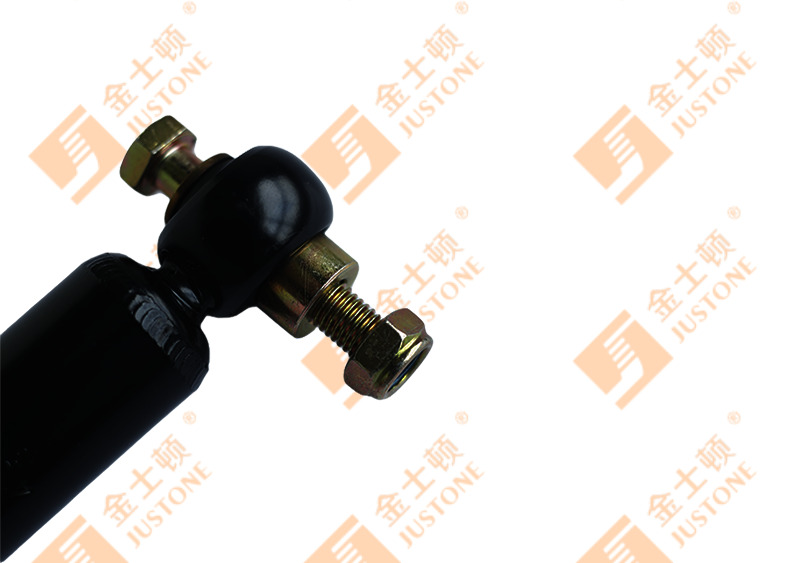
Regardless of whether your vehicle runs hydraulic or gas shocks, worn dampers share the same symptoms. Catching them early protects not just ride comfort but also tire wear, braking performance, and overall vehicle safety.
As a general service interval, shocks should be inspected at 50,000 miles and replaced when wear symptoms appear, regardless of mileage. Vehicles operating in demanding conditions — heavy loads, rough roads, frequent off-road use — should be inspected more frequently. Driving on worn shocks does not just degrade comfort; it extends braking distances, reduces tire grip, and increases the risk of losing control in emergency maneuvers.
Contact us for the latest news.
Copyright @ Hangzhou Justone Industry Co., Ltd.
 OEM Commercial Vehicle Shock Absorbers Manufacturers
Wholesale Car Shock Absorbers Factory
OEM Commercial Vehicle Shock Absorbers Manufacturers
Wholesale Car Shock Absorbers Factory